Wild Camping in the UK and Ireland: Where It Is Actually Legal
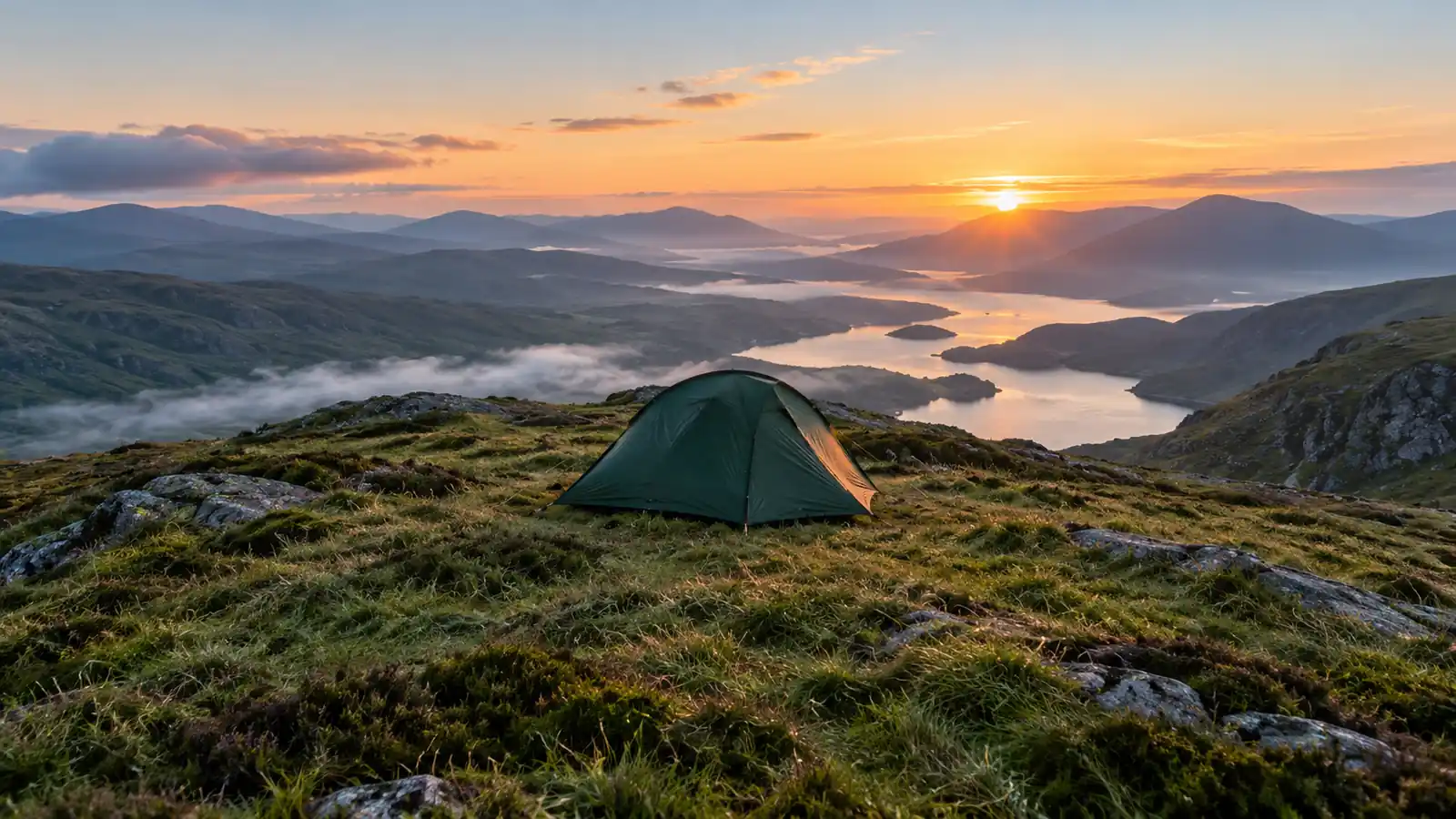
Wild camping in these islands is not one question with one answer. Scotland grants a broad right to camp responsibly on most land; Dartmoor has a narrower right confirmed by the Supreme Court in 2025; and across the rest of England, Wales and Northern Ireland you are camping with the landowner's permission or not at all.
This guide sets out each position separately, explains what responsible camping actually requires in the places where it is permitted, and covers the alternatives for everywhere else. Where rules are under review, that is flagged, because two of the key regimes are being reconsidered as this is written.
Four legal pictures on one map
Before any detail, get the geography of the law straight. These are different jurisdictions, and the rules of one do not transfer to another.
- Scotland. A statutory right of responsible access, including lightweight camping, over most land. Local byelaws apply in parts of one national park.
- Dartmoor, in Devon. A public right to backpack camp on certain commons, derived from a local Act of Parliament and subject to the national park's byelaws.
- The rest of England and Wales. No general right to camp. You need the landowner's permission.
- Northern Ireland. A separate legal system with no general right to camp. Permission again.
Ireland is a fifth picture, dealt with at the end, and it should not be treated as an extension of any of the above.
Scotland: the only general right in the UK
Scotland's position comes from the Land Reform (Scotland) Act 2003 and is explained in practice by the Scottish Outdoor Access Code. The Code's own summary is that you can enjoy the outdoors on most land if you act responsibly, and that this includes lightweight camping in a tent, in small numbers, and for no more than two or three nights in one place.
Each part of that sentence is a condition rather than a decoration.
- Lightweight. A tent you carried in. Not a trailer, not a large frame tent, and not a vehicle. Sleeping in a campervan is not covered by the access right.
- Small numbers. One or two tents, not a group encampment. Larger groups should be arranging a site.
- Two or three nights. Then move on. Returning to the same pitch repeatedly over a season is not what the right protects.
- Responsibly. The behaviours in the section below are what this word means in practice.
Where the Scottish right does not reach
The access right excludes land where camping would interfere with other people's privacy, livelihood or safety. In practice, keep away from:
- Houses, gardens and the land immediately around a building
- Enclosed fields holding crops or livestock
- Farmyards, working forestry operations and quarries
- Roadside verges and laybys, which are not what the right was written for
The Loch Lomond and the Trossachs exception
Inside Loch Lomond and The Trossachs National Park there are four camping management zones, covering West Loch Lomond, East Loch Lomond, Trossachs West and Trossachs North. Within those zones, camping byelaws operate from 1 March to 30 September each year, and during that season you need a permit or a pitch at a campsite. Outside those dates, and outside those zones, the general Access Code position applies.
Two things to do before a trip there. Check the permit map rather than relying on a description, because the zone boundaries are specific and the permit areas inside them are limited in number. And check the current status of the byelaws, which the park authority has confirmed it is reviewing, with public consultation planned. Take the rules from the park authority's own permit pages on the week you travel.
Dartmoor: a right confirmed in court
Dartmoor is the only place in England or Wales with a public right to backpack camp. It exists because of a local statute, section 10(1) of the Dartmoor Commons Act 1985, and its scope was settled by the Supreme Court in Darwall and another v Dartmoor National Park Authority, decided on 21 May 2025. The court held that the public right of access to the commons for open-air recreation includes backpack camping, subject to the park authority's byelaws.
Note what that does and does not mean. It is a right on the Dartmoor commons, not across the whole national park, and not across Devon. The byelaws remain fully in force, and they are specific:
- Use the park authority's interactive camping map before you plan the trip. It shows where you can backpack camp without seeking the landowner's approval. The authority is explicit that you must check it in advance, and it is the only reliable statement of where camping is permitted; a written description, including this one, will always lag behind it.
- One or two nights in a place, then move on.
- A small tent, pitched out of sight of roads and buildings.
- Small groups. The byelaws cap group size, and the limit is low.
- No fires and no barbecues. This is absolute on the moor, and the reason is fire risk on deep peat and dry gorse.
- No overnighting in a vehicle or campervan. The right covers a tent you walked in with.
The park authority has its own byelaw review under way, so the detail of the code may shift. Check its camping pages close to your trip rather than relying on a saved summary.
England, Wales and Northern Ireland: permission, in practice
Everywhere else, the starting point is that pitching a tent on land you do not own or rent requires the owner's permission. Camping without it is widely described as a civil matter between you and the landowner rather than a criminal offence, but the position varies between these jurisdictions, and Northern Ireland has an entirely separate legal system in which English and Welsh assumptions do not apply. If you need a definitive answer for a specific place, take it from the landowner or from legal advice, not from a general guide.
The practical route is more straightforward than it sounds. Permission is often granted if you ask properly:
- Ask the day before, not at dusk. A phone call to a farm in the afternoon is received very differently from a knock at nine in the evening.
- Be specific. One small tent, one night, arriving late, leaving early, no fire, nothing left behind. Say where you would like to pitch and offer to move if it suits them better.
- Know who to ask. Hill farms, estates, forestry managers, water companies and local councils are the common owners of open ground. Tenants rather than owners often make the decision in practice.
You will also hear that camping is "tolerated" high on the fells in parts of the Lake District, in Snowdonia and in the Yorkshire Dales, above the intake walls and away from paths. Toleration is a description of how landowners and national park authorities tend to respond, not a right, and it depends entirely on camping to a standard that leaves no trace. It is withdrawn where that standard slips, and each national park publishes its own position.
The behaviours that keep access open
Wherever you camp, this is the part that determines whether wild camping remains possible for the people behind you.
- Arrive late, leave early. Pitch at dusk, strike camp soon after dawn. A tent pitched at lunchtime looks like an occupation rather than a night's sleep.
- Carry everything out. That includes food waste, tea bags, fruit peel and anything that was burned but did not burn fully.
- No open fires. Use a stove. Fires scar ground for years, and on peat they can smoulder underground. Where fires are explicitly permitted, never take standing or fallen wood from the hill.
- Deal with human waste properly. Go at least thirty metres from water, dig a hole at least fifteen centimetres deep, bury the waste, and carry out all paper and hygiene products.
- Wash away from water. Carry water to your washing-up spot rather than scrubbing pans in the burn, and use biodegradable soap sparingly or none.
- Keep dogs under control, and keep them away from livestock and ground-nesting birds entirely during the spring and summer. On access land, lead restrictions apply at certain times of year.
Alternatives when wild camping is not an option
If you cannot get permission, or the weather or the season rules it out, the following give you a comparable experience legally:
- Wild-style and off-grid campsites. A marked field or woodland with no facilities beyond water and a compost toilet, often bookable for a single pitch.
- Bothies. Simple unlocked shelters, mostly in Scotland, maintained by volunteers. They are free, first-come and never guaranteed, so carry a tent as a backup. The etiquette is strict: leave it cleaner than you found it, carry out all rubbish, bring your own fuel if there is a stove, make room for latecomers, and keep groups small. A bothy is not a bookable hut.
Kit and safety for British and Irish conditions
The weather, not the law, is what most often turns a wild camp into a bad night. Plan for wind and sustained rain rather than cold alone.
- A tent that handles wind, with pegs suited to soft ground and spare guylines. Exposed high pitches are colder, windier and wetter than the forecast for the nearest town suggests.
- An insulated sleeping mat. Ground conducts heat away faster than air; the mat matters as much as the bag.
- Dry layers kept dry, inside a liner bag. Condensation inside a tent will wet anything left loose.
- Map and compass, and the ability to use them. Phone navigation is useful until the battery is cold and flat.
- Tell someone your plan. Where you intend to pitch, your route, and when you will be in touch. Then tell them when you are down.
- Expect no mobile signal. In the Highlands, the Hebrides, much of mid-Wales and the Mournes, assume you have none. Register for the emergency text service in advance.
- Midges, in Scotland, from roughly late spring to early autumn. A head net weighs almost nothing and changes the evening entirely.
Ireland
In the Republic of Ireland there is no general public right to camp on private land, and most upland and coastal ground is privately owned even where it looks open. The practical position is the same as in England and Wales: ask the landowner. National parks and nature reserves set their own rules for their own ground, and some prohibit camping outright, so check with the specific park rather than assuming a national position. Leave No Trace Ireland is the standard reference for behaviour, and following it is what keeps informal access tolerated.
Before you go
Work out which of the five pictures above applies to your destination, then take the detail from the body that administers that place: the Access Code for Scotland, the national park authority for Loch Lomond and the Trossachs or for Dartmoor, and the landowner everywhere else. Both rights-based regimes are under review, so check the relevant authority's own pages in the week you travel.
Sources
- Scottish Outdoor Access Code, practical guidance on camping, and the Land Reform (Scotland) Act 2003
- Loch Lomond and The Trossachs National Park Authority, camping byelaws, management zones and permit guidance
- Dartmoor National Park Authority, camping guidance, byelaws and interactive camping map
- The Supreme Court of the United Kingdom, judgment in Darwall and another v Dartmoor National Park Authority, 2025
- Dartmoor Commons Act 1985
- UK Government, the Countryside Code for England and Wales
- Mountain Bothies Association, bothy code and etiquette
- Leave No Trace Ireland, outdoor ethics guidance
- Met Office, mountain and upland weather forecasts