UK Airport Liquid Rules: Airport by Airport, Because They Still Differ
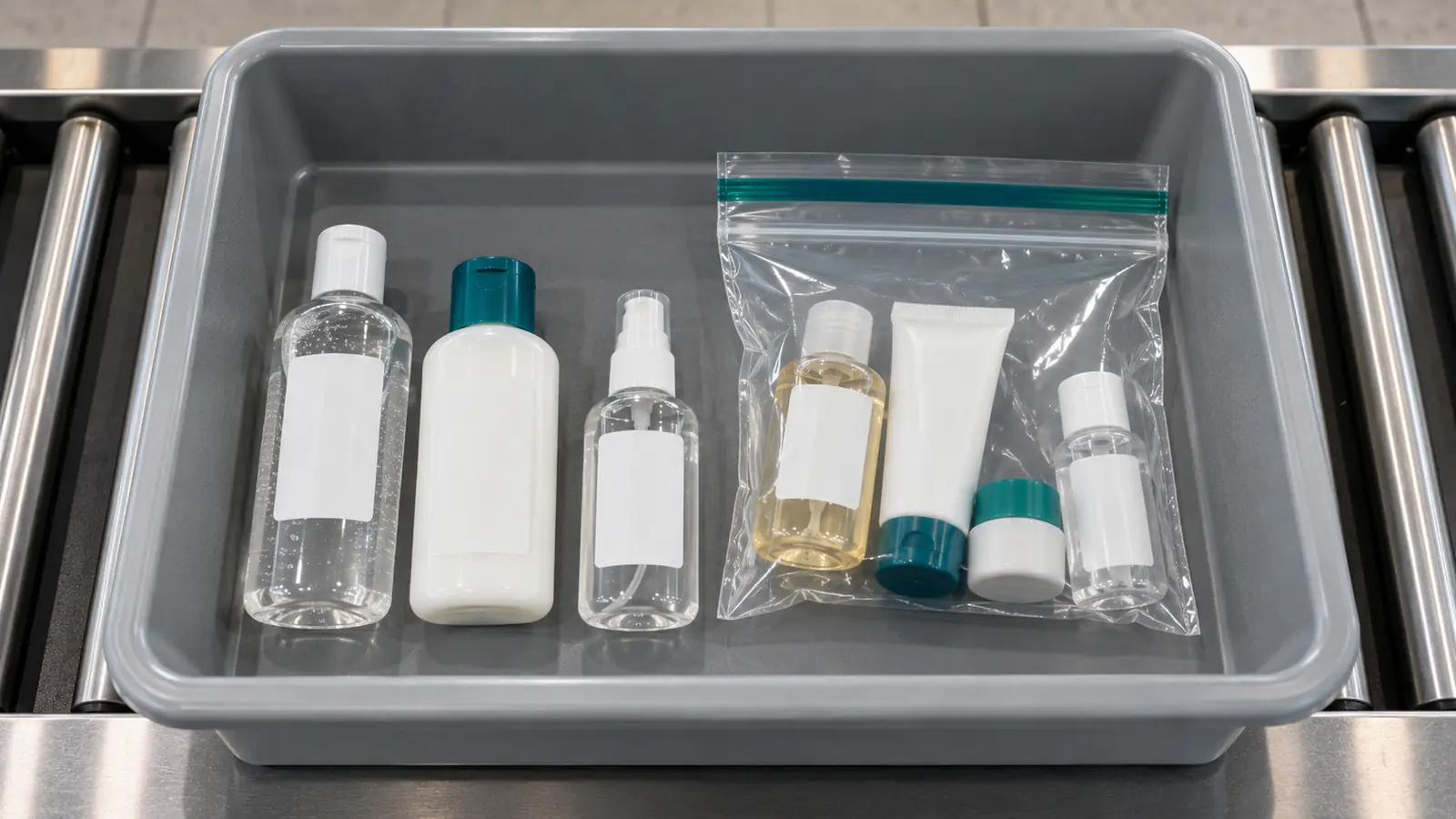
There is no longer a single liquid rule across UK airports. Some have installed next-generation security scanners and allow containers of up to two litres in hand baggage; others still hold to the long-standing 100ml limit. The rule that applies to you is set by the airport you are departing from, on the day you depart.
This guide sets out the default position, lists the major airports where it has changed and where it has not, and covers the exemptions and catches that no airport page spells out in one place. Verify your own airport before you pack, because individual airports update their pages at different times.
The default rule, and why it stopped being universal
UK government guidance on hand luggage restrictions still states that at most airports you cannot take liquids through security in containers larger than 100ml. It then adds that some airports may allow containers holding up to two litres, and it tells you to check the rules at the airport you are flying from. That sentence is the whole story: the national default is 100ml, and the two-litre allowance is a local exception granted where the equipment supports it.
The equipment in question is computed tomography screening, which produces a three-dimensional image of your bag. Where it is installed and certified, security officers can resolve what is inside a container without you removing it, so the restriction on container size can be relaxed and liquids can stay in the bag. Certification is granted airport by airport, and at some sites terminal by terminal, which is exactly why the picture is uneven.
One consequence is worth internalising now: the relaxed rule applies to departures from that airport. It is not a passport you carry with you. Your return flight is governed by the airport you fly home from, wherever in the world that is.
Where each major airport stands
The table below reflects what each airport operator published at the time of writing. Treat it as a map of the landscape rather than a guarantee, and check your airport's own security page close to your travel date.
| Airport | Limit on individual liquid containers | Clear plastic bag |
|---|---|---|
| Heathrow | Up to 2 litres | Not required; liquids can stay in the bag |
| Gatwick | Up to 2 litres | Not required |
| Edinburgh | Up to 2 litres per container | Not required |
| Birmingham | Up to 2 litres, no limit on the number of containers | Not required |
| Belfast International | Up to 2 litres, left in hand luggage | No longer required |
| Manchester | 100ml per container | Not required |
| Stansted | 100ml per container | Not required |
| Luton | 100ml per container | Not required |
| Glasgow | 100ml per container | Not required; containers may stay in cabin baggage |
| Liverpool | 100ml per container | Not required |
Two groups of airports are missing from that table deliberately. Belfast City, London City and Bristol are frequently listed in press coverage as two-litre airports, but their current positions could not be confirmed from the operators themselves for this guide, so no figure is given here. If you are flying from any of the three, read the operator's own security page and take the limit from there.
Everywhere else, including smaller regional airports, assume 100ml until the airport's own page says otherwise. The absence of a published change is not evidence of a change.
The trap inside the two-litre airports
A relaxed container limit does not mean an absence of rules. Three catches recur:
- Metal and double-walled containers must be empty. Insulated flasks, metal water bottles and travel mugs defeat the scanner's imaging, so expect to be asked to empty them regardless of the liquid allowance.
- Route-specific restrictions still override the airport rule. Heathrow, for example, notes that even under its two-litre allowance, liquids in containers over 100ml cannot be taken on flights to Australia. If your destination has its own inbound rule, that rule wins.
- Officers retain discretion. Any item can be subjected to further screening, opened, tested or refused. A published allowance is not an entitlement.
What counts as a liquid
The category is far wider than drinks, and this is where most confiscations happen. Treat the following as liquids for screening purposes:
- Water, soft drinks, hot drinks, soups and syrups
- Creams, lotions, oils, balms and sun cream
- Gels, including hair gel and shower gel
- Pastes, including toothpaste, and spreads of a paste-like consistency
- Mascara, liquid foundation, lip gloss and nail varnish
- Deodorants, perfumes and aerosol sprays
- Contact lens solution
- Jams, honey, yoghurt, soft cheeses and anything else that can be poured, squeezed or spread
Solid equivalents are not liquids, which is a genuine workaround at 100ml airports: a shampoo bar, a solid deodorant, toothpaste tablets and a powdered supplement all travel unrestricted. If you fly regularly from an airport that still enforces 100ml, switching two or three products to solid form does more for you than any packing trick.
Exemptions that follow the passenger, not the airport
Some categories are treated separately from the general liquid rule, at both 100ml and two-litre airports. In every case the quantity permitted is what is reasonable for your journey, and you should be prepared to declare the items and present them for separate screening.
- Essential medicines, including liquid medicines. Carry them in your hand baggage rather than in the hold, keep them in their original labelled packaging, and bring supporting documentation such as a prescription or a letter from your doctor or pharmacist. This matters most for anything injectable, anything refrigerated, and anything in a container that exceeds the airport's limit.
- Medical equipment and associated liquids, including items for diabetes management, continuous positive airway pressure devices, feeding solutions and the cool packs that keep them usable.
- Baby food, baby milk and sterilised water for an infant you are travelling with. You may be asked to taste these.
- Special dietary requirements, where a liquid or paste is a medical necessity rather than a preference.
Two practical points. The exemption covers screening, not your airline's cabin baggage weight and size allowance, so a bulky medical bag may still need to be agreed with the carrier in advance. And exempt items are usually screened by a separate process that takes longer, so arrive earlier than you otherwise would.
Your return flight, and connections
This is the single most common way a relaxed UK rule costs someone their shopping.
If you depart from a two-litre UK airport with a large bottle of something in your bag, you have to get it home through a security checkpoint somewhere else. Most airports outside the UK still apply a 100ml limit, and a transfer on the way home usually means passing through security again. The bottle that left Edinburgh without comment can be taken from you at an intermediate airport on the way back.
The same logic governs duty-free purchases. Liquids bought airside are normally sealed in a tamper-evident bag with the receipt visible, and the seal is what persuades security at a connecting airport to let them through. Keep it sealed until you reach your final destination, keep the receipt inside it, and if you are connecting through a country with its own rules on sealed bags, check before you buy rather than after.
If you are travelling with hold baggage, the simplest answer to all of this is to put large liquids in the hold, inside a sealed bag in case of leakage, and keep only what you need for the flight in the cabin.
Electronics, power banks and the rest of the tray
Liquids are not the only thing that changes at the checkpoint. At most airports with the newer scanners, laptops and tablets can also stay in your bag, which is why the trays move faster than they used to. At airports that still use older equipment, large electronics come out and go in a tray on their own.
Batteries are a separate matter and are governed by aviation rules rather than airport rules. Spare lithium batteries and power banks must be carried in the cabin, never in checked baggage, and they must be protected against short circuit. Airlines set their own limits on battery capacity and on the number of spares, and these limits genuinely differ between carriers, so no figure is given here: read your airline's dangerous goods page and the Civil Aviation Authority guidance on carrying batteries before you fly with a large power bank or any specialist battery.
Also expect attention on e-cigarettes and vapes, which must travel in the cabin and must not be charged or used on board, and on sharp items, tools and sports equipment, where the dividing line between cabin and hold is set nationally rather than by the airport.
Packing to clear security first time
- Check your departure airport's own security page within a week of flying, and note which rule applies.
- Pack liquids in one accessible place in the bag, even where you no longer need to remove them. If you are asked, you will not be unpacking everything.
- Empty metal and insulated bottles before you join the queue. Refill them after security.
- Keep medicines separate, with their labels and documentation, and declare them rather than waiting to be found.
- Take nothing you would mind losing. If a product is expensive or irreplaceable, it belongs in the hold or at home.
- Pack for the strictest checkpoint on the whole itinerary, not the most generous one.
- Clear your pockets into the bag before the queue, and know where your boarding pass is.
If something is taken from you
Security officers can refuse any item, and an item surrendered at the checkpoint is not recoverable afterwards, so the decision point is before you reach the belt. If you realise in the queue that you are carrying something that will not pass, your options are to return to the check-in desk if there is time and hold baggage is available, to use any left-luggage or posting service the airport offers, or to hand the item to whoever has come to see you off.
If you believe a rule has been misapplied, ask politely for a supervisor at the time, since that is the only moment at which the decision can be revisited. Complaints afterwards go to the airport operator, which is responsible for how screening is delivered on its site. Keep your boarding pass and note the time and lane, because that is the information any later enquiry will need.
The habit that saves you
The useful takeaway is not a list of allowances, since those will keep changing as more scanners are certified. It is the habit of checking two things before every trip: the security page of the airport you are leaving from, and the security page of the airport you are coming home through. Those two pages, read for your own dates, outrank any summary, including this one.
Sources
- UK Government, hand luggage restrictions at UK airports, including the guidance on liquids and on medicines
- Civil Aviation Authority, guidance on prohibited items, lithium batteries and passenger rights
- Heathrow Airport, security and baggage guidance
- London Gatwick, airport security guidance
- Edinburgh Airport, airport security guidance
- Birmingham Airport, security and customs advice
- Belfast International Airport, hand luggage and security guidance
- Manchester Airport, Stansted Airport, Luton Airport, Glasgow Airport and Liverpool John Lennon Airport, security guidance published by each operator
- Which?, consumer reporting on the status of the 100ml rule at UK airports