Chasing the Northern Lights in the UK and Ireland: How to Read the Forecast
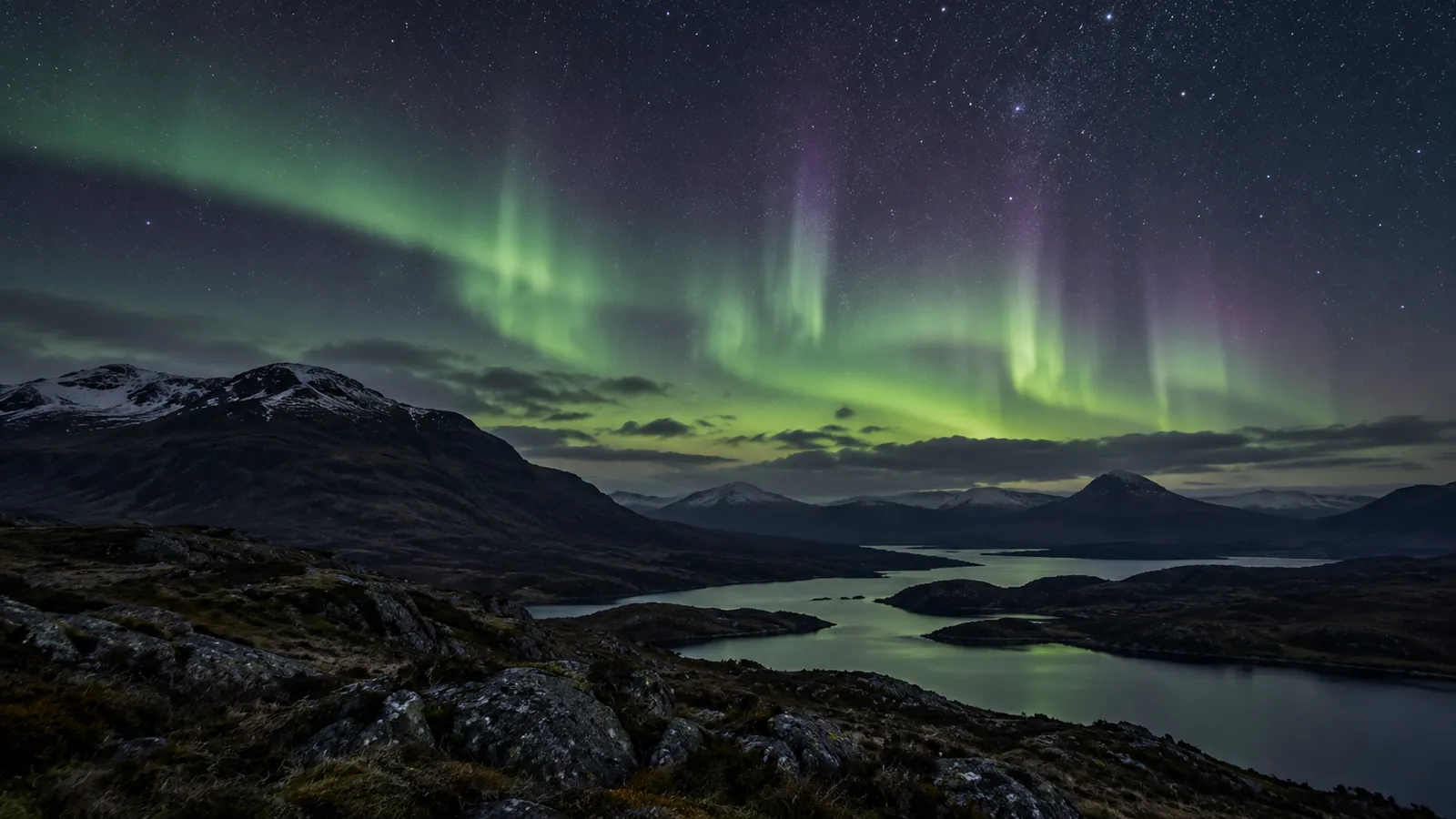
Seeing the northern lights from the UK or Ireland is a matter of three things lining up on the same night: geomagnetic activity, clear sky, and a dark northern horizon. Most failed trips fail on the second, and most disappointed travellers set out because of a headline rather than a forecast.
This guide is about the skill rather than the promise. It explains where the solar cycle actually stands, how far south sightings are realistically expected, and how to read the forecasts yourself so that you can decide, on any given evening, whether it is worth driving out.
Where the solar cycle actually stands
You will still read that the Sun is "at the peak" of its eleven-year cycle. It is not. The scientific panel convened by NASA and the United States National Oceanic and Atmospheric Administration announced that solar cycle 25 reached its maximum phase on 15 October 2024, and the cycle has been in its declining phase since.
That is a correction, not a reason to give up. Two points follow from it:
- Strong geomagnetic storms remain common in the declining phase. Historically, some of the most significant storms have occurred on the downslope of a cycle rather than at the peak, because long-lived coronal holes and large active regions persist well after the maximum.
- Nobody can promise you an aurora months in advance. The useful planning horizon is days, not seasons. Anything that commits to a specific night more than a week out is marketing.
The practical conclusion is to plan trips around dark skies and clear weather, which you can forecast, and to keep your plans flexible enough to react when the geomagnetic forecast improves.
How far south is realistic
The Met Office's position is clear and worth taking literally: the northern lights are most visible in Scotland, northern England, North Wales and Northern Ireland, and during intense solar storms they can be seen much further south.
Read that as two separate statements. The first describes where a sighting is a reasonable expectation on an active night. The second describes an exception that depends on a strong storm, and it is the reason that photographs from southern England appear in the news and then do not recur for a long time. Met Office forecasts for individual events typically describe likely sightings across northern Scotland, with a chance elsewhere in Scotland and perhaps northern England and similar latitudes where skies are clear. Southern counties do not usually appear in those forecasts at all.
So if you live in the south of England, you can see the aurora, but you should treat it as an exceptional event to react to rather than a trip to plan. If you live in or can reach the north, you can plan around it properly.
One more thing the geography does not tell you: cameras are far more sensitive than the human eye. Many reports of a southern sighting describe a faint glow that was obvious in a long exposure and nearly invisible to the naked eye.
The three factors that decide your night
Work through these in order. If any one of them fails, the other two cannot rescue the evening.
1. Geomagnetic activity
This is whether there is an aurora at all, and how far from the poles it has pushed. The standard measure is the Kp index, which runs from 0 to 9 and summarises global geomagnetic disturbance over a three-hour period. Higher values mean the auroral oval has expanded towards the equator, so a sighting from lower latitudes becomes possible.
Resist the temptation to memorise a Kp number for your town. Those thresholds circulate widely, they vary between sources, and they ignore the direction and structure of the solar wind, which matters as much as the headline figure. Use the wording in the Met Office space weather forecast, which names the regions where sightings are likely or possible, and the alert levels published by AuroraWatch UK, which are designed for UK observers. Both of those do the interpretation that a raw number cannot.
2. Cloud
Cloud is what defeats most attempts, and it is the factor you have the most control over, because you can drive to a better forecast. Check the cloud cover forecast for your intended spot, not for the nearest city, and check the hour you intend to be there. In the west of Scotland and Ireland, a clear slot of two hours is a realistic target rather than a whole clear night.
3. The Moon, and local light
A bright Moon washes out faint aurora, so the nights around a new Moon are better than the nights around a full one. The Moon's phase is predictable months ahead, which makes it the one factor you can genuinely use to choose dates in advance. Streetlights, floodlit car parks and passing headlights do the same thing on a smaller scale, which is what the choice of location is for.
How to read a solar activity forecast
The forecasts you will use come in three timescales, and knowing which is which stops you misreading them.
- Days ahead. When a coronal mass ejection leaves the Sun, its arrival can be estimated a day or more in advance, with meaningful uncertainty on both timing and strength. This is your cue to start watching, and the point at which it is reasonable to clear an evening.
- Hours ahead. As the disturbance approaches, forecasts firm up and the Met Office space weather forecast will say which regions have a likely or possible chance, and when. This is your go or no-go decision, taken together with the cloud forecast.
- Minutes ahead. Measurements from spacecraft upstream of the Earth give very short notice, well under an hour, of the solar wind conditions actually arriving. This is what drives real-time alerts, and it is why aurora watching rewards being out there and ready rather than waiting for certainty.
Set up alerts rather than refreshing pages. AuroraWatch UK, run by Lancaster University, issues alerts based on magnetometer readings from UK sites, which is about as locally relevant as it gets. Read its alert levels once so that you know what each means before the night you need it.
Two bits of vocabulary that help you understand what you are reading. A coronal mass ejection is a discrete cloud of solar material that produces a sharp, relatively predictable storm. A coronal hole high-speed stream is a persistent fast flow that can produce recurring moderate activity, often returning on a roughly monthly rhythm as the Sun rotates.
Where to go
The further north, the better the odds, but the quality of the site matters nearly as much as the latitude.
- Shetland and Orkney. The best odds anywhere in the UK, with the added advantage of open northern horizons over the sea.
- Caithness, Sutherland and the north Highland coast. Mainland Britain's strongest combination of latitude and darkness.
- The Outer Hebrides, Skye and the west coast. Excellent darkness and horizons, with the trade-off of frequent Atlantic cloud.
- The Moray coast and Aberdeenshire. Often drier than the west on the same night, and well placed for a northern sea horizon.
- Northumberland and the North Pennines. England's best realistic bet, with extensive dark-sky areas.
- The Lake District and North Wales. Possible on active nights, with the usual caveat about mountain cloud.
- The Causeway coast, the Sperrins and the Mournes, in Northern Ireland. Northern horizons over water and genuinely dark inland areas.
- Donegal, Mayo and the Irish north-west. The Republic's best odds, with some of the darkest skies in Europe.
Choosing a spot once you are in the right region
- An unobstructed northern horizon is the single most important feature. Looking north over water or over a low plain beats any amount of altitude with a hill in the way.
- Use dark-sky parks and reserves as a shortlist. They are, by definition, places with protected darkness and usually with parking and some information.
- Park legally and considerately. Do not block passing places, field gates or farm tracks, and do not leave a vehicle on soft verges.
When to go
The season is the dark half of the year, because you need genuine darkness, and in the far north of Scotland there is not enough of it in midsummer. Within that, the Met Office notes that the best chance of seeing the northern lights in the UK is around the equinoxes and solstice period, in March and April and in September and October. Those months tend to combine long dark hours with a seasonal tendency to stronger geomagnetic activity.
Within a night, the hours either side of midnight are usually the most productive, though a strong storm can produce a display at any time it is dark. Plan to be in position and settled before you expect anything, give your eyes at least twenty minutes to adapt to the dark without looking at a phone screen, and be prepared to wait. Displays often come in bursts separated by quiet periods, so leaving after half an hour of nothing is how people miss the good part.
Photographing it
You do not need professional equipment, but you do need a few settings and something to hold the camera still.
- A tripod, or anything solid. A wall, a fence post or a bag on the car roof will do. Handheld shots of faint aurora do not work.
- On a phone, use night mode or a long-exposure mode, turn off the flash, and lock the focus on something distant or set it to infinity. Several seconds of exposure is usually enough to show colour your eyes cannot see.
- On a camera, start with the widest aperture your lens offers, a high but not extreme sensitivity, and an exposure of a few seconds. Then adjust: brighten if the frame is dark, shorten the exposure if the structure is smearing.
- Keep spare batteries warm in an inside pocket. Cold flattens them quickly.
- Expect the camera to see more than you do, and do not let that spoil the night. Looking up matters more than the photograph.
Dress for standing still in the dark
You will be stationary outdoors for hours, often by the coast, in winter, so wear far more than you would for walking and add an insulated layer for when you stop moving. Bring a hat, gloves you can operate a camera in, a flask, a sitting mat, a red-light torch to preserve your night vision, and a charged phone, with your plans shared with someone at home.
Plan B for a cloudy night
Build the trip so that a cloudy night is still worth having, because most nights will be cloudy.
- Stargazing proper. A dark-sky site rewards a clear, aurora-free night with the Milky Way, meteor showers in season and easy binocular targets.
- Daylight on the same routes. The regions with the best aurora odds are also the ones with the best coastline, the fewest crowds and the shortest winter queues at attractions.
- Book two nights, not one. Doubling your attempts does more for your chances than any other decision, and it costs less than a wasted long drive.
The realistic expectation
Set out expecting to learn how to read a forecast, to spend some cold evenings seeing nothing, and to be surprised when it works. Watch the space weather forecast, watch the cloud, go north when both agree, and go twice.
Sources
- Met Office, space weather forecast and specialist forecasts
- Met Office, learning resources on the northern lights and on optical effects
- AuroraWatch UK, Department of Physics, Lancaster University
- NASA, announcement on the Sun reaching the maximum phase of solar cycle 25
- National Oceanic and Atmospheric Administration, Space Weather Prediction Center
- DarkSky International, directory of dark-sky places