Flying Between the UK and Ireland: What ID You Now Need
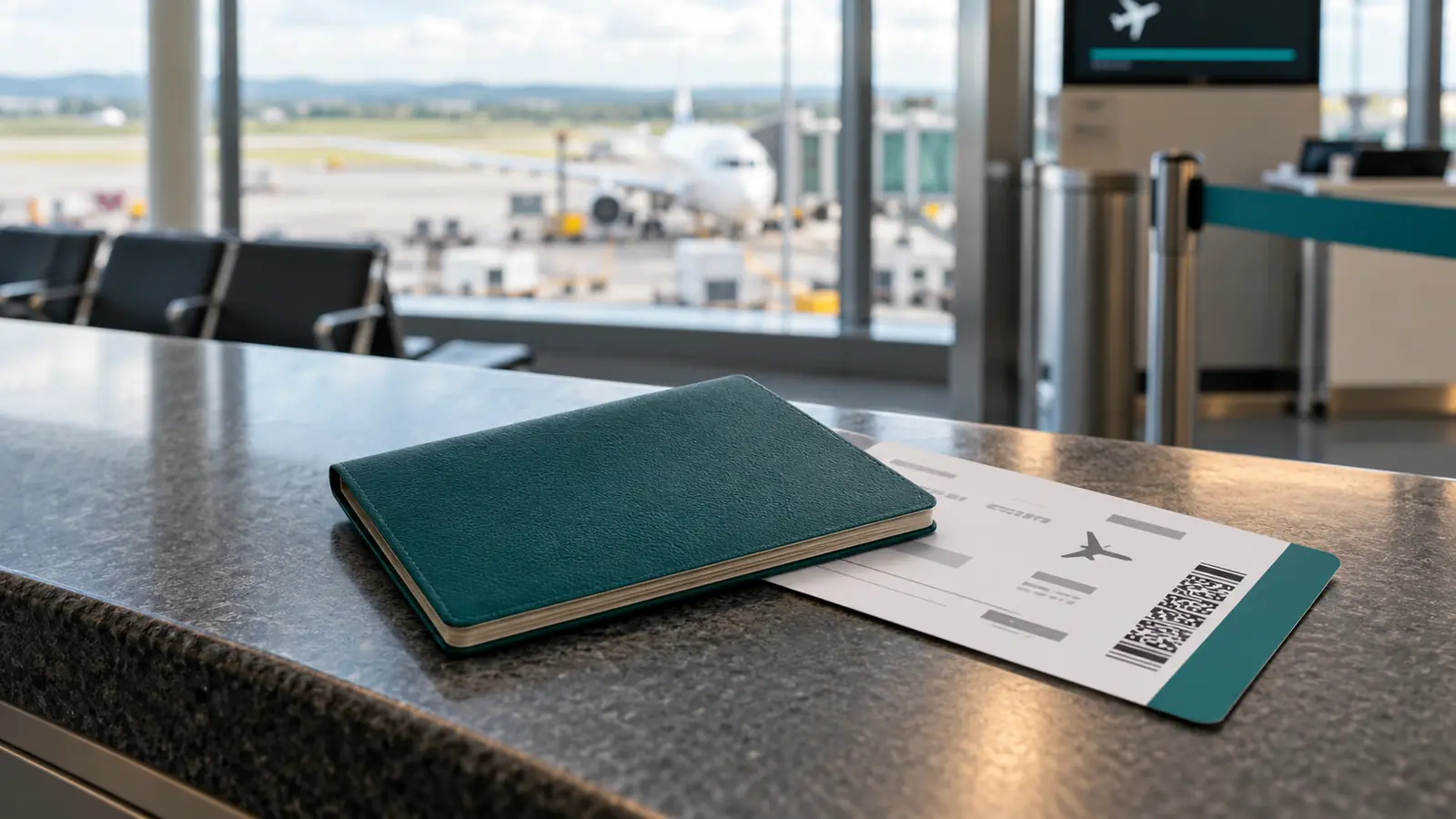
If you have flown between Britain and Ireland before, you may remember being waved through with a driving licence, a bus pass, or nothing at all. That memory still reflects the law. It no longer reflects what every airline will accept at the check-in desk, and the gap between the two is where travel plans fall apart.
This guide separates the legal position from the carrier's position, sets out the change that takes effect on 25 February 2026, and shows you where to look so that you arrive at the airport with the document your airline will actually accept.
Two different questions, routinely confused
When someone tells you that you do not need a passport to fly to Dublin, and someone else tells you that you do, both can be right, because they are answering different questions.
- What does immigration law require? This is about your right to enter the country, and it is governed by the Common Travel Area arrangement between the United Kingdom and Ireland.
- What does your carrier require? This is a contract question, set out in the airline's conditions of carriage and its travel documents policy. The airline decides what it will accept in order to let you check in and board.
Almost nobody is turned away by an immigration officer on these routes. People are turned away at check-in desks and boarding gates, by staff applying their employer's rules. So the practical answer to "what ID do I need" is always the carrier's answer, not the legal one.
What the Common Travel Area actually gives you
Under the Common Travel Area, British and Irish citizens can move freely between the two countries. The UK government's foreign travel advice for Ireland is explicit that a British citizen does not technically need a passport to enter Ireland. The same advice carries two warnings that matter.
First, Irish immigration officers can ask you to prove that you are a British citizen, and a passport is the simplest way to do that. Second, and more importantly, the advice notes directly that some airlines and ferry operators have introduced, or will be introducing, a passport-only identification requirement. The Common Travel Area does not bind a commercial carrier, and the carrier's rule is the one enforced at the desk.
It also helps to know which kind of journey you are making. A flight between Belfast or Derry and anywhere in Britain is a domestic UK flight. A flight between Dublin, Cork, Shannon or Knock and Britain is an international flight, even though it stays inside the Common Travel Area. Carriers often write different rules for those two cases, which is why two people travelling on the same morning can be told two different things and both be correct.
The change that takes effect on 25 February 2026
Aer Lingus has confirmed that from 25 February 2026 it is updating its travel document requirements for flights between Ireland and the UK. All customers, including Irish and British nationals, travelling on Aer Lingus and Aer Lingus Regional services between Ireland and the UK will need a valid passport or an Irish Passport Card to check in for and to board their flight, in both directions. Other forms of photo identity card will no longer be accepted.
Three details are easy to miss, and all three catch people out:
- It applies regardless of nationality. Being Irish or British does not exempt you.
- It applies in both directions, so your return leg is covered as well as the outbound.
- It applies at check-in and at the gate, which means an online check-in that went through is not proof that you will be boarded.
The exceptions that matter in Belfast and Donegal
The new requirement does not extend to every Aer Lingus Regional service. On Aer Lingus Regional routes between Belfast and Britain, and on Dublin to Donegal, a driving licence continues to be accepted. The reason is the distinction above: those journeys stay within a single state, so they are not flights between Ireland and the UK.
If you live in Belfast, that exception is the difference between needing to organise a passport and not needing to. Do not act on it blindly, though. Belfast also has services that are Ireland to UK journeys, and the exception is written around specific routes and a specific operator. Check which carrier and which service your booking is on, and read that carrier's own travel documents page for your date, before you decide you are covered.
Do not apply one airline's rule to another
Because the Aer Lingus change was widely discussed, it has been repeated as though every airline on the Irish Sea adopted the same policy on the same date. That is not the case, and acting on the generalisation can send you to the airport with the wrong document, or send you to buy a passport you did not need.
Ryanair, for example, did not introduce a change on 25 February 2026. It has never accepted a driving licence as a travel document, so there was nothing for it to withdraw. Its rules for UK domestic routes, which include Belfast to Britain, are set out in its own general conditions of carriage and travel documents guidance, and they are not the same as the rules for international routes. Read them for your own journey rather than assuming in either direction.
What counts as acceptable identification
Across these routes, the documents that carriers generally treat as valid are few:
- A valid passport. Accepted everywhere, and the document that removes all doubt.
- An Irish Passport Card. A card-format document issued to Irish citizens who already hold a valid passport book. It is accepted in place of a passport under the Aer Lingus requirement described above.
- A national identity card. Whether one is accepted depends entirely on the carrier, on your nationality and, if you are not a British or Irish citizen, on your immigration status.
Treat everything else as unacceptable unless the carrier says otherwise in writing: driving licences outside the specific exceptions above, provisional licences, bus and rail passes, workplace or student cards, proof-of-age cards, and photographs or scans of documents held on your phone. A document that has expired is not a valid document, however recently it lapsed.
Ferries, coaches and cross-border trains
Air travel is the strictest case, but it is not the only one.
Ferries. Sea operators also set their own rules, and the UK government's advice flags that some ferry operators are moving to passport-only identification as well. Most ask for photo identification at check-in, particularly for foot passengers.
Coaches and trains across the Northern Ireland to Ireland land border. There is no routine immigration control on the land border and no document check when you board. Carry photo identification anyway. You will very likely need it at the other end for a hotel, a hire car or a bank.
If you are not a British or Irish citizen
Common Travel Area rights belong to British and Irish citizens. If you hold another nationality, the two countries' entry requirements apply to you separately, and permission to be in one of them is not permission to enter the other.
Travel with your passport, plus any residence permit, visa or immigration document that evidences your status, and check the published entry requirements for both the UK and Ireland for your nationality before you book. Your carrier may also require more from you than it requires from a British or Irish passenger. The UK government's foreign travel advice for Ireland and the Irish Department of Foreign Affairs guidance on travelling to Great Britain are the two places to read first.
Children and teenagers
Carriers set their own minimum age at which a passenger must present identification, so look it up for yours.
Two situations deserve preparation. If you are travelling with a child whose surname differs from yours, or travelling as one parent without the other, nothing on these routes routinely requires you to prove the relationship, but you may be asked questions. Carrying a copy of the birth certificate and a short signed letter of consent from the other parent costs nothing and resolves the conversation quickly. If a child is flying alone, unaccompanied minor travel is a service you must arrange with the airline in advance, with its own age rules, paperwork and charges. It cannot be organised at the airport on the day.
Validity, and the myth about six months
The widely repeated rule that a passport must have six months of validity left comes from the entry requirements of other destinations. It is not a Common Travel Area requirement, and these routes are not where it originated.
What carriers on these routes ask for is a valid passport, so the practical questions are simpler: does it expire before your return date, and does the name on it match the name on the booking? Renew in good time, and check your carrier's exact wording if your document is close to expiry. The UK and Irish passport services publish current processing times, so take the figure from them.
Checklist before you book, and again before you fly
- Identify the operating carrier, not just the airline you booked with. Code-share and franchise services are common, and the operating carrier's rules apply.
- Establish whether your route is domestic or international, using the Belfast-versus-Dublin distinction above.
- Read the operating carrier's travel documents page for that route type, on or close to your travel date.
- Check expiry dates and name spellings for everyone on the booking, children included.
- Photograph your documents and keep the copies somewhere separate from the originals.
- If you are relying on an exception, such as a Regional route that still accepts a driving licence, save or print the carrier's own page stating it.
- If you are not a British or Irish citizen, carry your immigration documents and check both countries' entry requirements.
If your document goes missing the night before
Work through this in order rather than hoping the desk will be sympathetic.
- Report the loss to the police and to the relevant passport service. Be aware that reporting a passport lost or stolen cancels it, so a document that later turns up cannot be used.
- Contact the passport service about urgent options. Both the UK and Irish services operate faster, appointment-based routes. Availability, timescales and cost change, so telephone and ask rather than relying on a figure you have read somewhere.
- Telephone the airline before travelling to the airport. Explain the situation and ask what, if anything, it will accept. Do not simply turn up and hope.
- Consider a different mode. A ferry operator, or a rail and sea combination, may accept documents your airline will not. Confirm with that operator first.
The one habit worth keeping
A guide, this one included, can tell you how the system works and where the current traps are. It cannot tell you what your airline will accept on your date. Before every trip between the UK and Ireland, spend two minutes on your operating carrier's own travel documents page. That habit, rather than a memorised rule, is what gets you on the plane.
Sources
- Aer Lingus, travel information on passports and visas for travel between Ireland and Britain
- Ryanair, general conditions of carriage and travel documentation guidance
- UK Government, foreign travel advice for Ireland, entry requirements
- Department of Foreign Affairs of Ireland, travel advice for Great Britain and Common Travel Area guidance
- NI Direct, travel and cross-border information for Northern Ireland residents
- His Majesty's Passport Office, passport application and renewal guidance
- Passport Service, Department of Foreign Affairs of Ireland, passport and Passport Card guidance